Needlepoint vs. Embroidery: What's the Difference?
Needlepoint is a kind of embroidery. What sets it apart is the canvas, and the canvas changes the stitches, the needle, and the frame.
Needlepoint is embroidery worked on canvas. The Royal School of Needlework (RSN) calls it canvaswork, a form of counted embroidery that covers the whole surface with stitches, and the Embroiderers' Guild of America (EGA) calls needlepoint the American term for canvas embroidery. So needlepoint is not an alternative to embroidery but one kind of it.
The Victoria and Albert Museum's guide to embroidery styles separates counted kinds, where each stitch covers a set number of threads in the ground, from freestyle or surface embroidery, where the design is not bound by the weave. The museum lists canvas work and cross stitch among the counted kinds. This page sets needlepoint beside freestyle embroidery, the kind stitched along a design drawn on fabric, with cross stitch alongside. Our needlepoint vs. cross stitch guide takes cross stitch on its own.
On this page: canvas, Aida, and fabric, the stitches, the needle and the frame, what each is used for, side by side, which is easier, where the cost goes, crewel and other relatives, and FAQ.
Canvas, Aida, and fabric
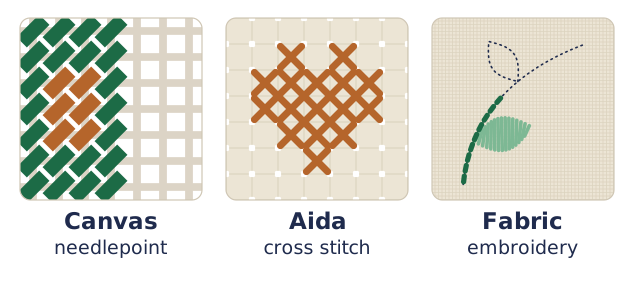
Needlepoint is worked on canvas, which the EGA's glossary describes as a stiff, heavily starched, lattice-like weave of cotton, silk, linen, or man-made fibers, from 4 to 64 threads to the inch. Canvas comes with single threads (mono canvas), with pairs of threads (Penelope), or with threads locked in place where they cross (interlock). Erica Wilson, with shops on Nantucket and Martha's Vineyard, puts the difference this way in its guide to canvas: unlike fabric for cross stitch or embroidery, needlepoint canvas is stiff and open, "with visible holes that guide your needle." Our mesh count guide explains what the number of threads to the inch means for a project.
Counted cross stitch can be worked on any evenweave fabric, the EGA says, and its glossary describes Aida as an evenweave used especially for counted cross stitch. The Cross Stitch Guild describes Aida as fabric woven with its threads grouped into bundles that form a pattern of squares, which leaves obvious holes, and the stitches go through those holes. DMC calls Aida's count the number of stitches you can make in an inch, and recommends 14-count Aida for beginners.
Freestyle embroidery needs no grid to count. The EGA's guide to embroidery fabrics suggests plain weave, whose grid is much less distinct, for surface and freestyle work that relies less on a grid, and names linen and muslin among its examples. With no holes to count, the design is drawn onto the fabric first, for instance traced with a transfer pen, as DMC shows. Crewelwork, embroidery in wool, is worked on linen, the RSN says.
Counted and covering, or free
On canvas, the stitches follow the threads. The Victoria and Albert Museum says canvas work is most often done in tent stitch, which it calls a diagonal or half cross stitch. Canvas work designs, it adds, generally cover the canvas completely, making the pattern with colored yarns. The EGA's glossary defines tent stitch as a diagonal stitch over one canvas intersection, where two threads cross, and adds that in traditional canvaswork every part of the canvas is stitched.
The embroidery site Needle 'n Thread describes two ways a needlepoint design can come: counted onto blank canvas from a chart, or painted on the canvas, so that you cover each painted area in the corresponding color of thread. Needlepoint is not limited to tent stitch, either. The EGA's glossary says any embroidery stitch can be used on canvas, and our stitch guide has tent stitch three ways and the stitches to learn after it.
A cross stitch is two diagonals, the second laid over the first, as the museum describes it. The museum's other name for tent stitch, half cross, shows the link: a tent stitch is one diagonal, and a cross stitch lays a second over it. Our stitch guide also uses the name for one of the three ways of working tent stitch. Cross stitch designs are usually not printed on the fabric, DMC says; a chart shows where each stitch goes, square by square.
Freestyle embroidery follows the traced design instead of the weave. Crewel, the EGA says, is worked freely rather than counted. Its stitches come from several families: flat stitches such as backstitch, stem stitch, and satin stitch; loop stitches such as chain stitch; knots such as the French knot; and couched and laid stitches. The RSN says a basic crewelwork design can use six to ten different stitches.
The needle and the frame
Needlepoint uses a tapestry needle, which the EGA's glossary describes as blunt, with a long oval eye, in sizes 13 to 26. John James, the English needle maker, says the blunt round point lets the needle slip between canvas threads and yarns without splitting or tearing them. Embroidery needles are sharp: the glossary describes crewel or embroidery needles as long and sharp with large eyes, in sizes 1 to 10. A sharp needle pierces the fabric, and a blunt one deflects its threads, the EGA explains. Cross stitch uses the blunt kind too; John James says its finer tapestry needles, sizes 22 to 28, are the ones commonly used for cross stitch. Our supplies guide gives the needle size for each mesh.
For needlepoint, the EGA's glossary names two kinds of frame, scroll frames and artist's stretcher bars, and says a frame helps keep the canvas from distorting as you work, so that little or no blocking is needed afterward. Blocking, which our framing guide describes, dampens a stitched canvas, with water or steam, and squares it back into shape. NeedlepointTeacher.com says stitches come out much more even on stretcher bars, for new and experienced stitchers alike. A hoop, two rings that fit together over the fabric, is another way to hold work taut. Nordic Needle's guide says a majority of stitchers use a hoop for cross stitch and for Brazilian embroidery, while frames and stretcher bars are often used for needlepoint and for large cross stitch pieces. It warns that a hoop can distort the stitching caught in it and break some threads.
What each is used for
Canvas work has long gone into furnishings. The Victoria and Albert Museum lists bed hangings, decorative hangings, pillow covers, and upholstered furniture from the sixteenth century onward, and the RSN names seat covers and rugs. Needle 'n Thread adds footstool covers, chair seats, framed pieces, book covers, purses and bags, and doorstops. Lycette Designs in Palm Beach, in its guide to types of needlepoint, names things that need to withstand wear, in its words, such as upholstery, handbags, and belts. Our finishing guide covers what it costs to have a stitched canvas made into a pillow, an ornament, or a stocking.
Freestyle embroidery has gone into furnishings and clothing alike. The museum describes crewelwork on bed hangings and curtains in England in the late seventeenth and early eighteenth centuries, and Lycette names clothing, table linens, and wall art. Cross stitch traditionally decorated household linens, the EGA says, and samplers kept it alive; today, in the EGA's words, it is primarily used to create decorative rather than utilitarian items.
Side by side
- The ground. Needlepoint: stiff, open canvas. Cross stitch: Aida or another evenweave. Embroidery: a close weave such as linen or muslin.
- The main stitch. Needlepoint: tent stitch, one diagonal over one crossing of threads, and many others. Cross stitch: two diagonals, crossed. Embroidery: a range of stitches, from backstitch and satin stitch to chain stitch and French knots.
- Placing the stitches. Needlepoint: counted from a chart, or following the colors painted on the canvas. Cross stitch: counted from a chart, or worked over a printed design. Embroidery: along a design traced onto the fabric.
- Thread. Needlepoint: almost any thread, among them wool, cotton, silk, and blends, in enough strands to cover the canvas. Cross stitch: stranded cotton floss. Embroidery: often six-strand cotton floss, one or two strands at a time, though the EGA names rayon, silk, metallic, and wool threads too; two-ply crewel wool for crewelwork.
- The needle. Needlepoint and cross stitch: a blunt tapestry needle. Embroidery: a sharp embroidery or crewel needle.
- Holding it taut. Needlepoint: often stretcher bars or a scroll frame. Cross stitch and embroidery: a hoop, or a frame for a large piece.
- Typical pieces. Needlepoint: pillows, seat covers, belts, bags, ornaments, and stockings. Cross stitch: samplers, household linens, and framed pieces. Embroidery: clothing, table linens, and curtains.
Which is easier?
None of the sources we read measures one against the other. What differs is what you learn first.
Needlepoint on a painted canvas starts with one stitch and the colors in front of you. NeedlepointTeacher.com rates continental, a tent stitch worked in rows, as "Easy," and one stitch is enough to finish a first canvas, as our how to start guide explains. The holes of the canvas place every stitch, and the paint shows which color goes where.
Cross stitch starts with counting. DMC says Aida's obvious holes make it easy for beginners to form neat stitches, and suggests starting at the center of the chart and the center of the fabric, then counting holes from there.
Freestyle embroidery asks for more stitches sooner, placed along the traced line rather than counted. The RSN, which teaches both crewelwork and canvaswork, calls crewelwork an ideal technique for beginners new to embroidery, with six to ten different stitches in a basic design. It describes its class "Introduction to Canvaswork" as suitable for all levels.
If you want to try more than one, some needlepoint shops carry the others too. When we checked their sites in September 2026, Rittenhouse Needlepoint in Philadelphia listed cross stitch and embroidery beside needlepoint, and threads from Appleton crewel and tapestry wool to DMC embroidery floss. The Petite Poppy Stitch House in Friendswood, near Houston, listed needlepoint canvases, cross stitch patterns, Aida and linen cloth, and embroidery patterns and kits. And Creative Needle Arts in Gulf Shores, Alabama, gives its goal in its own words as "to support the needs of hand embroidery enthusiasts of all types," whether cross stitch, needlepoint, crewel, surface embroidery, or wool applique.
Where needlepoint's cost goes
Needlepoint's cost starts with the canvas. Lycette Designs describes each hand-painted canvas as individually crafted by an artist who paints the design onto the canvas, and says hand-painted canvases are often more costly. They also usually come without thread, which you choose separately, as our kit guide explains. In the shop catalogs we read for our guide to why needlepoint is so expensive, the median hand-painted canvas cost $78, before any thread. That guide has prices for each kind of canvas, and for thread and finishing, and our stocking guide adds up what a stocking costs.
Printed canvases are the other route. Lycette says their designs are applied by machine and they are often mass-produced, which makes them an accessible and cost-effective option for beginners, though not always recommended for a first project. It adds that printed canvases can have errors that make matching thread color and direction harder. Pre-printed kits usually include their thread, and the kit guide compares them. For embroidery, the EGA recommends six-strand cotton floss to beginners, in part because it is easy to find and inexpensive.
Crewel and other relatives
- Crewel is embroidery in wool. The EGA describes it as surface stitchery in a loosely twisted two-ply wool on a firm fabric, worked freely rather than counted, and the Victoria and Albert Museum says its name comes from that yarn, crewl. The same wool goes on canvas too: our thread guide gives one or two strands of Appleton crewel wool for 18-mesh, from Rittenhouse Needlepoint's listings.
- Petit point and gros point are needlepoint named by the size of the stitch. The museum describes petit point as canvas work in tiny stitches on the finest canvas, and notes that Mary, Queen of Scots, worked it to pass the time during her long imprisonment by her cousin, Elizabeth I. Gros point, in the EGA's glossary, now means very large tent stitches.
- Berlin woolwork, the museum says, was "a form of hard-wearing needlepoint embroidery in which a single type of stitch is worked on canvas fabric," stitched from patterns printed on squared "point" paper. The patterns were first produced in Berlin in the 1800s, and by 1840, the museum adds, more than fourteen thousand of those patterns had been imported into Britain. For a time in the nineteenth century, Nordic Needle says, Berlin work was another name for canvaswork.
- Bargello is needlepoint in upright stitches stepped into peaks and valleys. Our Bargello guide covers it.
- Needlepoint lace is a different thing under the same word: the EGA's glossary also uses needlepoint for lace made with a needle, from buttonhole stitches.
FAQ
Is needlepoint a type of embroidery?
Yes. Needlepoint is embroidery worked on canvas. The Royal School of Needlework calls it canvaswork, a form of counted embroidery, and the Embroiderers' Guild of America calls needlepoint the American term for canvas embroidery.
Can you use embroidery floss for needlepoint?
Yes, with more strands. Embroidery on fabric typically uses one or two strands of six-strand floss at a time, by the EGA's account. The thread chart of Needlepoint.Com, which has shops in Charleston and Raleigh, gives four strands of floss for 18-mesh and seven or eight for 13-mesh. Our thread guide covers the other needlepoint threads.
Can I use an embroidery needle for needlepoint?
Use a tapestry needle instead. An embroidery needle is sharp and pierces what it passes through, while the blunt point of a tapestry needle slips between canvas threads and yarns without splitting them, as the EGA and John James describe the two.
Can you use an embroidery hoop for needlepoint?
It is a personal choice, Nordic Needle's guide says, but frames and stretcher bars are often used for needlepoint, and the guide warns against catching stitching in a hoop, which can distort it and break some threads. A frame also helps keep the canvas from distorting as you work, the EGA's glossary says. Stretcher bars come in pairs that slot together at the corners, Nordic Needle explains, and the canvas is tacked to them.
Is needlepoint the same as tapestry?
No, though the names get mixed. A tapestry is woven, not stitched, Nordic Needle points out, and the Royal School of Needlework says needlepoint is sometimes incorrectly called tapestry. The word stays in the names of the tapestry needle and tapestry wool. The Bayeux Tapestry is an exception: despite its name it is stitched, and the EGA counts it as the earliest surviving crewel embroidery, from 1067 to 1070.
Can I use embroidery stitches on a needlepoint canvas?
Yes. The EGA's glossary says any embroidery stitch can be used on canvas, and Needle 'n Thread notes that needlepoint now regularly takes in other stitches, sometimes decorative embroidery stitches. The American Needlepoint Guild's definition takes in counted and free stitching alike: the Textile Research Centre in Leiden gives it as "any form of counted or free style stitchery worked by hand with a needle and thread on a countable ground." Our stitch guide includes the French knot, one of the knots the EGA lists among crewel stitches.
Is needlepoint good for beginners?
A first canvas needs only one stitch, tent stitch, which NeedlepointTeacher.com rates "Easy" in its continental form, and a painted canvas shows where each color goes. Our how to start guide covers what to buy and how to make the first stitches, and which is easier, above, compares the first steps in cross stitch and embroidery.
Is cross stitch a kind of embroidery?
Yes. The Victoria and Albert Museum lists cross stitch among the counted kinds of embroidery and calls it one of the oldest, with the earliest existing example from AD 850. The Royal School of Needlework's Stitch Bank puts the earliest evidence of cross stitch later, in thirteenth-century burials in Lebanon. Our needlepoint vs. cross stitch guide compares it with needlepoint.
A local shop can put canvas and thread in your hands, and some carry cross stitch and embroidery supplies too. Our region pages list the shops we have checked by hand.
Find a Needlepoint Shop Near YouThis page was checked in September 2026 against the Royal School of Needlework, the Victoria and Albert Museum, the Embroiderers' Guild of America's glossary and beginner guides, the Textile Research Centre in Leiden, Nordic Needle's guides on needlery.org, NeedlepointTeacher.com, Needle 'n Thread, John James needles, DMC, The Cross Stitch Guild, and the shops' own sites. The figure was drawn for this page from those descriptions. The canvas price comes from the shop catalogs read for our cost guide on September 28, 2026.