Needlepoint Thread Types: Wool, Cotton, and Silk
What each one is like to actually stitch with, and how much of it you need for your canvas.
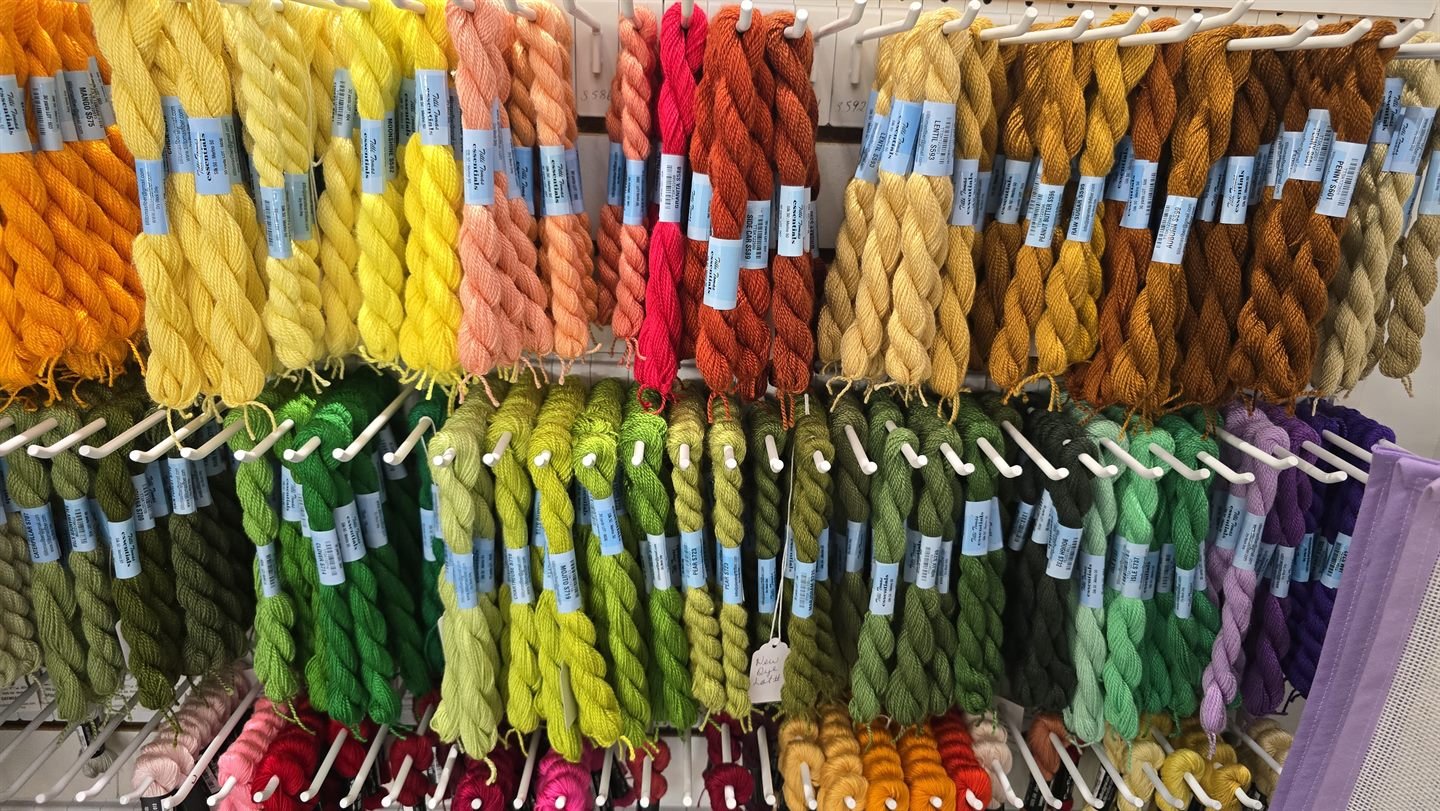
Thread is the decision that trips up more new stitchers than anything else, and it is easy to see why. A shop wall holds dozens of options in a hundred colors, most of them look lovely, and almost nothing on the label tells you which will behave on the canvas in your hand.
The good news is that it comes down to two questions. What is the thread made of, and how much of it do you need to cover your mesh?
Wool
Wool is the traditional needlepoint thread and still the most widely used. The fibers are slightly fuzzy, and that fuzziness is the whole point: it fills small gaps and quietly hides the uneven tension that every beginner has for the first few hours.
It is also hard-wearing, which matters for anything that gets handled. Pillows, purses, belts, and chair seats are wool territory.
Best for: first projects, large background areas, and anything that will be touched.
Cotton
Cotton floss is the most affordable and the easiest to find. DMC is stocked almost everywhere, in a color range nothing else matches. Stitches come out crisp, with a soft sheen rather than a shine.
The tradeoff is that cotton is less forgiving than wool. It has no fuzz to hide behind, so uneven tension shows. That is not a reason to avoid it, just a reason not to start a large background with it on your very first canvas.
Best for: detail work, defined shapes, and stitching on a budget.
Silk
Silk is the one people fall for. It pulls through the canvas beautifully and has a depth of sheen that neither wool nor cotton comes close to, which is why it turns up on faces, water, sky, and anywhere a piece needs to catch the light.
It is also the most expensive and the least forgiving. Silk shows every inconsistency, snags on a rough fingernail, and is not the thread for something that will get daily handling.
Best for: accents and focal areas on a piece you are taking your time over.
Silk and wool are also sold blended together, often about half and half. A blend keeps a good deal of the sheen while getting back some of the forgiveness of wool, which is a fair compromise if you cannot decide between the two. Read the band on the skein rather than going by eye, because a good blend looks like silk from a few feet away.
How much thread covers your canvas
This is the part that is genuinely useful to know before you buy, and it is why the same thread appears in different quantities in different projects.
Most needlepoint threads are made of separable strands, so you adjust coverage by changing how many you stitch with. A finer canvas needs fewer strands, a coarser canvas needs more. These are the usual starting points:
- Persian wool (three separable plies, such as Paternayan). Two plies for 13-mesh, one ply for 18-mesh.
- Crewel wool (such as Appleton). Two strands for 13-mesh.
- Tapestry wool. A single strand, not separable, made to cover around 13-mesh as it comes.
- Cotton floss (such as DMC). Six strands for 13-mesh, fewer as the mesh gets finer.
- Stranded silk. Roughly the same as cotton, six strands for 13-mesh.
Treat those as a place to begin rather than a rule. Coverage also depends on which stitch you are using and how tightly you work, so the honest method is to stitch a small test patch in a corner and look at it. If canvas shows through, add a strand. If the stitches look crowded and bulky, drop one.
If you are not sure what mesh you are working on, our mesh count guide explains how to read the number and what it means for your project.
Metallics and specialty threads
Metallic threads add sparkle, and they are a common choice for a name banner on a Christmas stocking or for small accents on an ornament. They also tangle, fray, and generally misbehave more than any other thread on this page.
Use short lengths, expect to go slower, and save them for small areas rather than a whole background. They are worth the trouble in the right spot and genuinely miserable in the wrong one.
Which should a beginner buy?
Wool, if you have the choice. It is the most forgiving thread there is, and forgiveness is the single most useful quality when your tension is still settling down.
In practice, though, most first projects settle this for you. Pre-printed and all-in-one kits arrive with thread already matched to the canvas, which is one of the better reasons to start with a kit rather than assembling pieces yourself. See our guide to choosing a first kit for more on that.
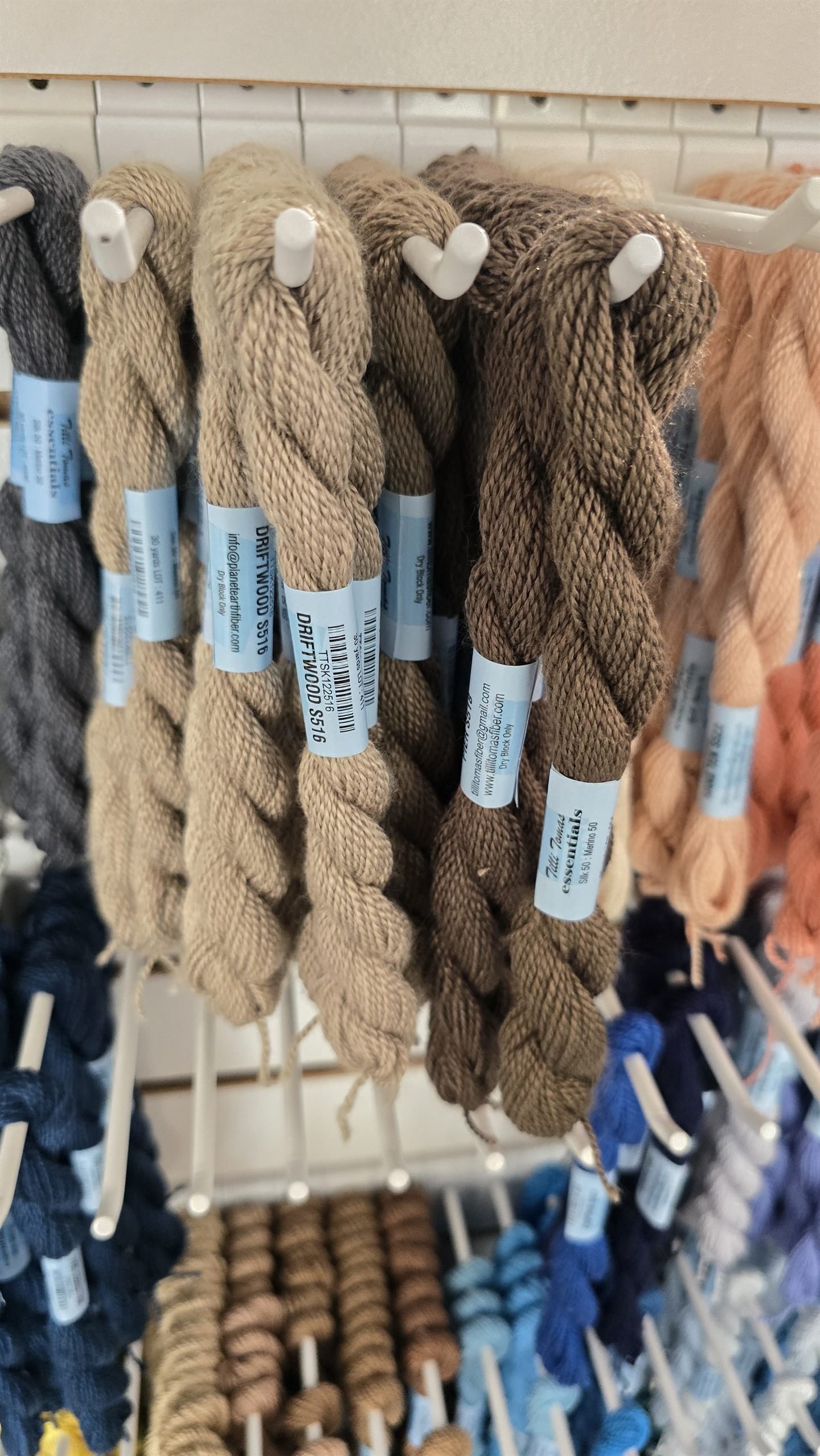
Hand-painted canvases are where you choose for yourself, and that is a good moment to stand at a shop counter with the canvas in your hand. Thread is very hard to judge from a photograph. Color reads differently under shop light, sheen barely photographs at all, and the difference between wool and silk is something you understand in about two seconds of touching both.
When you would rather order online, our starter supplies guide has our picks for thread along with everything else.
Looking after thread
- Work in shorter lengths. Around 18 inches is the usual advice. Longer lengths fray from being dragged through the canvas over and over.
- Keep it out of the sun. All three fade, and silk fades fastest. That applies to your thread stash as much as to a finished piece.
- Buy enough at once. Dye lots vary, and a color bought six months later may not quite match. If a background needs a lot of one color, get it in one go.
FAQ
Can I use embroidery floss for needlepoint?
Yes. Cotton embroidery floss is a perfectly normal needlepoint thread, and DMC is one of the most widely used. The thing to get right is the number of strands, because floss meant for embroidery on fabric will not cover needlepoint canvas at the strand count an embroidery pattern assumes.
Can I mix thread types on one canvas?
Absolutely, and plenty of finished pieces do. A wool background with silk accents is a common combination. Just keep coverage consistent so one area does not look thinner than another, and remember that silk and metallic areas will wear faster than wool ones.
How much thread do I need for a project?
It depends on canvas size, mesh count, and how much of the design is background. A shop can estimate it for you from the canvas itself, which is far more reliable than a rule of thumb. If you are guessing, err upward and buy the background color in a single dye lot.
Is wool or cotton better for a beginner?
Wool, in most cases. It hides uneven tension in a way cotton cannot, and uneven tension is the thing every beginner is working through. Cotton is still a fine choice, and it is cheaper, so it is a reasonable place to start if wool is not easy to find near you.
Thread is the one thing that is genuinely hard to judge online. A local shop will let you see and feel it.
Find a Needlepoint Shop Near You