Needlepoint Background Stitches: How to Choose One, with Diagrams
What to weigh when you choose a background, where the stitch guide's stitches fit, and seven more stitches with diagrams drawn for this page.
On a canvas with a design in the middle and open space around it, the background can be a large share of the stitching. The stitch you choose for it decides how much canvas shows, how much texture sits behind the design, and how long the piece takes.
Our stitch guide covers tent stitch and six stitches for texture, and the teachers and shops it cites recommend all six for backgrounds. This guide is about choosing a background stitch: what to weigh and where those stitches fit. Then come seven more stitches that the stitch guide does not cover, six of them for backgrounds and one, knitting stitch, for knitwear.
On this page: choosing a background, the stitch guide's stitches, diagonal mosaic, diagonal Scotch, cashmere, Parisian, knitting stitch, T-stitch, skip tent, and the FAQ.
How to choose a background stitch
Decide how much it should stand out
Start with the design. Needlepoint.Com, which has shops in Charleston and Raleigh, makes the point with a finished ornament, a cardinal on a mailbox. The decorative stitches, beads, and sparkly threads go on the cardinal and the mailbox, the focal point, and a light, open background around them adds texture without taking attention from the design. Unwind Studio, which publishes a stitch library online, gives similar advice, and adds the reverse as an option: a design in plain tent stitch with a textured background behind it.
Full coverage or light coverage
Stitches like basketweave and diagonal mosaic cover the canvas. Light-coverage stitches, also called openwork, leave canvas showing between the stitches. KC Needlepoint in Kansas City says of T-stitch that you will see some canvas through the stitches, and that this is intentional. It suggests a fine thread for T-stitch, like Petite Silk Lamé Braid, and Needlepoint.Com names the same thread for light-coverage stitches because it is thin and light.
Upright stitches, like brick and Parisian, let a little canvas show between them, so the thread matters there too. KC Needlepoint works Parisian in a flat thread, such as Neon Rays Plus, for better coverage.
Check that the pattern fits the space
Unwind Studio's rule of thumb is to ask whether the stitch's pattern will still be legible in the space. Small spaces take small stitches, like tent stitch and mosaic. A large background can take almost any stitch.
A background also meets the design at every edge, so its pattern gets cut all the way around. Where a whole unit will not fit, fill the gap with shorter stitches running the same way, which stitchers call compensating. Unwind Studio notes that most compensation stitches end up as tent stitches. The Needlepoint Clubhouse in Rock Hill, near St. Louis, says diagonal cashmere is easy to compensate because its stitches are short.
Weigh the time and the wear
Unwind Studio sorts background stitches by how fast they work up. Basketweave is slow; decorative stitches like brick, Nobuko, mosaic, Scotch, and corduroy are quick; and openwork stitches like T-stitch and skip tent are the quickest of its three groups.
For a piece that will be handled, the Royal School of Needlework's stitch bank calls basketweave the most hard-wearing of the three ways to work tent stitch, and ideal for chair seats and other pieces in heavy use. Basketweave also uses the most thread of the three.
Match the stitch to what the background shows
A background is not always plain. For a sky or water, our stitch guide lists brick and Nobuko, and Nobuko for snow. Unwind Studio recommends T-stitch and skip tent for skies. For walls, roofs, roads, and patios, The Needlepoint Clubhouse and Ridgewood Needlepoint in Wyckoff, New Jersey, suggest cashmere, and KC Needlepoint files cashmere, mosaic, and Scotch among its architectural stitches.
Try it in the margin first
Before you commit a whole background to a stitch, try a small patch of it in the blank canvas around the design, in the thread you plan to use. Unwind Studio also suggests testing stitches in that spare canvas.
Background stitches in our stitch guide
These seven are drawn and explained in our stitch guide. Each link goes to its section there.
- Basketweave: tent stitch in diagonal rows. It gives a smooth background, wears best of the three ways to work tent stitch, and pulls the canvas out of shape least.
- Brick: upright stitches in rows that interlock. It lets a little canvas show, and is used for skies, water, hills, and buildings.
- Scotch: squares of five diagonal stitches, three threads each way. It is used for buildings, borders, and backgrounds.
- Mosaic: small squares, two threads each way. It fills large backgrounds and small square spaces alike, and is easy to compensate.
- Nobuko: short and long diagonal stitches, alternating in rows. It is used for skies, water, snow, and fur.
- Corduroy: ribs of short and long stitches slanting opposite ways. It is recommended for backgrounds that need a lot of compensating, and for walls and floors.
- Byzantine: diagonal staircases of stitches. It is a busy stitch, for a background with movement.
How to read the diagrams
The diagrams below follow the stitch guide's, which explains them in full. The pale lines are canvas threads. The needle comes up at the odd numbers and goes down at the even ones, and only the first stitches are numbered. The knitting stitch diagram has no numbers; its caption gives the order. The two colors only tell parts of a pattern apart, and each caption or key says which is which. A paler stitch is one shortened to fit the edge of the drawing.
Stitches are measured by what they cross. A diagonal stitch over two crosses two intersections of the canvas, and an upright stitch over two crosses two canvas threads.
Five stitches for fuller coverage
Diagonal mosaic stitch
Diagonal mosaic is mosaic stitch run together into diagonal lines. Along each diagonal row, stitches over one intersection alternate with stitches over two, all slanting the same way. The Royal School of Needlework's stitch bank calls it condensed mosaic stitch, and finds it under the name German stitch in a handbook of 1842.
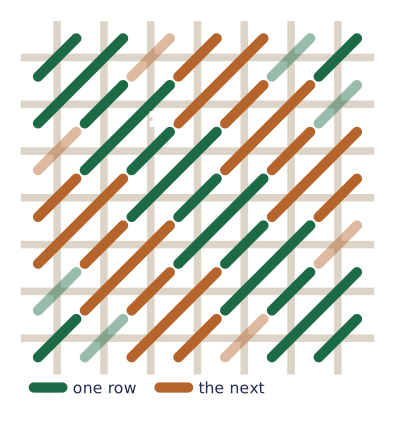
Start at the top left of the area with a stitch over one, made from bottom left to top right. Make a stitch over two just below it, and keep alternating down the diagonal. Work the next row back up beside the first, with each short stitch against a long stitch of the row before and each long stitch against a short one, so the rows lock together.
KC Needlepoint counts diagonal mosaic among the first decorative stitches it recommends learning, and suggests the stitch for a simple background.
Use it for: backgrounds, areas large and small, and flowers.
From a shop: KC Needlepoint has a diagram and a video of diagonal mosaic in its Stitch Vault.
Diagonal Scotch stitch
Diagonal Scotch runs Scotch squares together along a diagonal, each square sharing its shortest stitch with the next. The stitches go over one, two, three, and two intersections, then one, two, three, and two again, all slanting the same way. KC Needlepoint describes the result as a continuous run of small squares, and the Royal School of Needlework's stitch bank calls it condensed Scotch stitch.
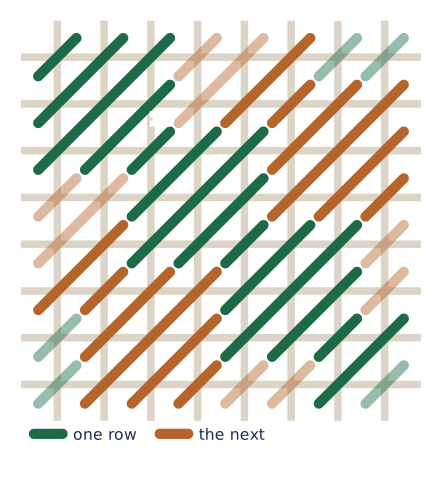
Work it in diagonal rows, down one row and back up the next. Each new row interlocks with the one before, its shortest stitches against the longest stitches of the last row and its longest against the shortest.
The stitch bank calls it "a flat medium-sized stitch that fills in quite quickly". KC Needlepoint suggests it for areas you want to have movement, and as a first decorative stitch to try.
Use it for: backgrounds, areas large and small, and anywhere you want movement.
From a shop: KC Needlepoint has a diagram and a video of diagonal Scotch.
Cashmere stitch
Cashmere stitch is a small upright rectangle, two threads wide and three high: a tent stitch, two stitches over two intersections, and another tent stitch, all slanting the same way. The blocks line up side by side and one above another, which gives a background a grid of small rectangles.
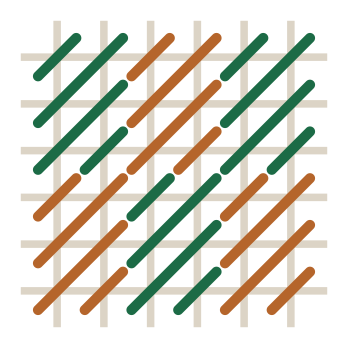
Make a tent stitch from bottom left to top right, then two stitches over two just below it, then a last tent stitch to close the block. Repeat the blocks in rows and columns. NeedlepointTeacher.com, the site of needlepoint teacher and author Susan Sturgeon Roberts, notes that you can work the blocks in rows or in columns and get the same result.
NeedlepointTeacher.com rates cashmere easy and lists it for most areas. Diagonal cashmere, a close relative, runs the blocks together down a diagonal, each block without its last tent stitch. The Needlepoint Clubhouse uses diagonal cashmere for backgrounds, and notes that diagonal cashmere covers the canvas fully.
Use it for: backgrounds and borders, and buildings, walls, roofs, roads, sidewalks, and patios. For stripes, The Needlepoint Clubhouse suggests a background in two colors.
From a shop: The Needlepoint Clubhouse has videos of cashmere and diagonal cashmere in its stitch library, and Ridgewood Needlepoint has diagrams of cashmere and several variations.
Parisian stitch
Parisian stitch alternates upright stitches over two and over four canvas threads along a row, each short stitch centered beside a long one. In the next row a short stitch goes under each long one and a long stitch under each short one, so the rows interlock. The stitch bank finds it under the name Josephine stitch in a British book of 1847.
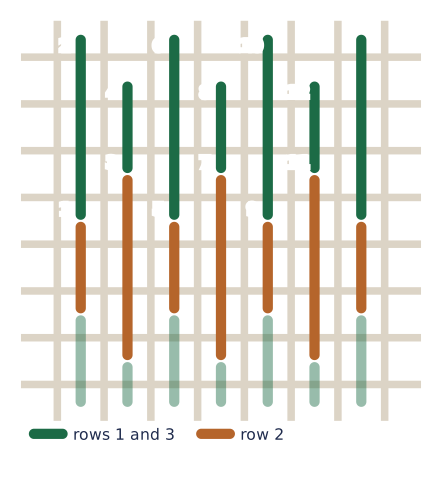
Work along the row, over four and over two in turn, then work the next row back, each stitch meeting the one above it in a shared hole. Like brick, it can let a little canvas show between its upright stitches, so the thread matters.
Hungarian stitch is a close relative: groups of three upright stitches over two, four, and two threads, which make small diamonds.
Use it for: backgrounds and other large areas, and flowers.
From a shop: KC Needlepoint has a diagram and a video of Parisian stitch.
Knitting stitch (Kalem)
Knitting stitch, also called Kalem, looks like knitted fabric. It is made of columns of slanted stitches, each column slanting the opposite way to the one beside it, so each pair of columns reads as a stack of V shapes.
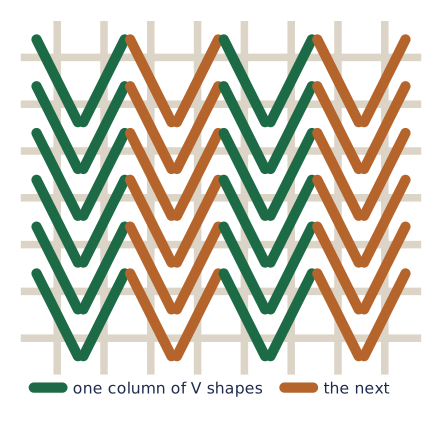
Make each stitch one thread across and two threads up. In Unwind Studio's order, work a column of them, each directly below the last, slanting up to the left. Then work back up beside it with stitches slanting up to the right, each sharing its bottom hole with the stitch beside it, and repeat the pair of columns across the area.
KC Needlepoint and Unwind Studio both give it as one thread across and two up. The stitch bank gives a steeper version, one across and four up, and calls the smaller one Elizabethan knitting stitch.
Use it for: knitwear in a design. KC Needlepoint suggests it for scarves, hats, sweaters, and mittens.
From a shop: KC Needlepoint has a diagram of Kalem stitch, and Needlepoint.Com has a video of knitting stitch.
Two light-coverage stitches
These two leave canvas showing between the stitches by design, so they give a background texture without drawing attention from the design. Both put a tent stitch on every other intersection, like the dark squares of a checkerboard. They differ in which way the stitches slant and in the order you work them.
T-stitch
T-stitch is made of rows of tent stitches over every other intersection. The next row sits one thread lower, in the gaps, and slants the other way, and the third row repeats the first. Needlepoint.Com describes it as tent stitches and reverse tent stitches in horizontal rows, and says the name comes from the small diagonal T shapes it makes on the canvas.
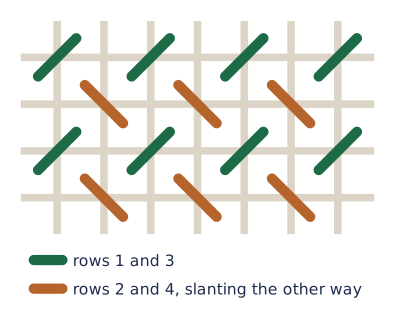
Work row 1 from left to right, each stitch from bottom left to top right, skipping one intersection between stitches. Work row 2 back from right to left, one thread lower and in the gaps, each stitch from bottom right to top left. Then repeat the two rows. That is the order in KC Needlepoint's diagram. Ridgewood Needlepoint's 2020 post on T-stitch notes that the front looks slightly different if you change the direction.
For a light blue sky, the same post suggests an overdyed thread, Waterlilies in the color Ice, in four strands on 18-mesh canvas and six on 13-mesh. For a lighter and quicker background still, Unwind Studio leaves two empty intersections between stitches instead of one.
Use it for: skies and large backgrounds. The same Ridgewood Needlepoint post describes using it as a background when the design should stand out and the background should recede.
From a shop: Needlepoint.Com has a video and a diagram of T-stitch, Ridgewood Needlepoint has a diagram, and KC Needlepoint has another.
Skip tent stitch
Skip tent is basketweave with every other diagonal row left out. Needlepoint.Com says it will come as second nature if you know basketweave, and that it forms subtle diagonal lines on the canvas.
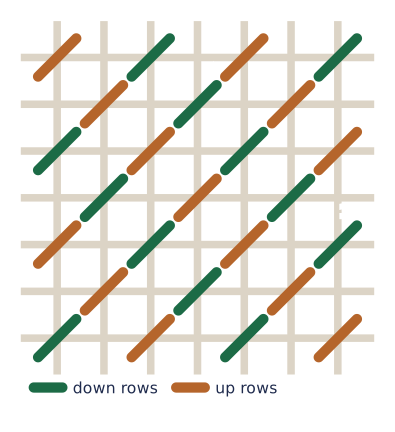
Work it in diagonal rows, down one and back up the next, as for basketweave, but move over two diagonals between rows instead of one. Unwind Studio, which also calls it basketweave twill, says to keep to the diagonal so that the thread on the back passes behind the skipped holes, which looks better from the front.
KC Needlepoint has a variation that works down each row in tent stitch and back up the next in reverse tent stitch, which it says is similar in effect to T-stitch.
Use it for: skies and large backgrounds.
From a shop: Needlepoint.Com has diagrams of skip tent and T-stitch in a post on openwork backgrounds. KC Needlepoint has a skip tent diagram and its variation, and Ridgewood Needlepoint shows skip tent with beads, added once the stitching is done.
FAQ
What is the best background stitch for needlepoint?
No one stitch suits every background. Basketweave gives a smooth, hard-wearing background but is slow to work. For texture, the teachers and shops cited here recommend diagonal mosaic, diagonal Scotch, cashmere, diagonal cashmere, and Parisian, along with the stitch guide's brick, Scotch, mosaic, Nobuko, corduroy, and Byzantine. For a background that stays behind the design, T-stitch and skip tent are light and quick. Choose by how much the background should stand out, the size of the space, and the time you have.
What is the easiest background stitch?
KC Needlepoint recommends diagonal mosaic as one of the first decorative stitches to learn, and diagonal Scotch as a first one to try. NeedlepointTeacher.com rates cashmere easy. If you already know basketweave, Needlepoint.Com says skip tent will come as second nature.
Should canvas show through a background stitch?
It can. Light-coverage stitches like T-stitch and skip tent leave canvas showing on purpose, for a background that stays behind the design. For full coverage, choose a stitch that covers, like basketweave, diagonal mosaic, or diagonal cashmere. With upright stitches like Parisian, use a thread thick or flat enough to fill the gaps.
What stitch should I use for a sky?
Our stitch guide lists brick and Nobuko for skies. Unwind Studio recommends T-stitch and skip tent, and a 2020 Ridgewood Needlepoint post suggests an overdyed thread for a light blue T-stitch sky.
What stitch should I use for a brick wall or a building?
Three of the shops cited here suggest cashmere: The Needlepoint Clubhouse for walls, roofs, and roads; KC Needlepoint for buildings and sidewalks; and Ridgewood Needlepoint for bricks and patios. NeedlepointTeacher.com lists diagonal cashmere for bricks, walkways, and buildings, and KC Needlepoint also files mosaic and Scotch among its architectural stitches.
How do I fill a background around a design?
Work the pattern as far as it fits, then fill each gap along the edge of the design with shorter stitches running the same way, so the pattern keeps its look. Stitchers call this compensating. Unwind Studio notes that most compensation stitches end up as tent stitches, and suggests laying a slip of paper over a printed diagram to see where the pattern will be cut.
What is the difference between mosaic and diagonal mosaic?
Both are made of stitches over one and over two intersections. Mosaic groups them into small squares, and diagonal mosaic runs them together into diagonal lines, as the Royal School of Needlework's stitch bank puts it.
Is knitting stitch the same as Kalem stitch?
Yes. They are two names for the same stitch, and the stitch bank adds kelim and kilim stitch, among others. Versions differ in how steep the stitches are: one thread across and two up, as drawn here, or one across and four up, as the stitch bank works it.
A local shop can suggest a background for your canvas and show you the stitch in person. Our region pages list the shops we have checked by hand.
Find a Needlepoint Shop Near YouThe stitches on this page were checked in September 2026 against the Royal School of Needlework's stitch bank, NeedlepointTeacher.com, Unwind Studio's stitch library and blog, and the stitch libraries and posts of the shops linked above. The diagrams were drawn for this page from those descriptions and diagrams.