Bargello Needlepoint: What It Is and How to Stitch It
Upright stitches stepped into peaks and valleys, row after row of color: how the pattern works, how to count it, and where the name comes from, with diagrams drawn for this page.
Bargello is needlepoint worked in upright stitches. The stitches climb and fall in steps, so each row rises and falls in peaks and valleys, and every row after the first follows the same line in another color. It also goes by the names Florentine work, flame stitch, Hungarian point, and Irish stitch.
The stitch itself is one straight stitch. What takes care is counting the first row, which every other row copies. This guide covers the stitch and the step, the first row, covering the canvas, and four-way Bargello, then where to find canvases, kits, and books. For tent stitch and the other stitches mentioned here, see our stitch guide.
On this page: what it looks like, the name, the stitch and the step, how the rows repeat, the first row, coverage, Bargello in a painted canvas, four-way Bargello, is it hard?, canvases, kits, and books, and FAQ.
What Bargello looks like
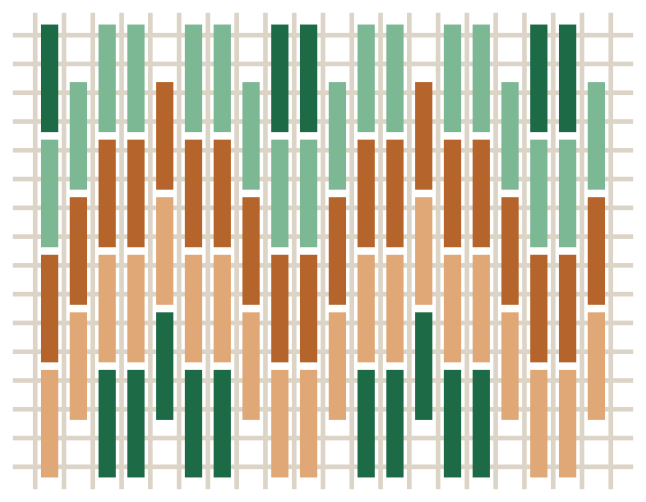
Bargello is counted work: the pattern is made by counting canvas threads. Its stitches lie straight along the threads, never on the diagonal. NeedlepointTeacher.com, the site of needlepoint teacher and author Susan Sturgeon Roberts, says you would never see a diagonal stitch in a true Bargello.
The Victoria and Albert Museum describes the classic design: in each row, neighboring stitches jump two threads up or two down, making regular peaks and valleys that look like bands of waves. The Royal School of Needlework's stitch bank calls the flame or wave, where the colors rise and fall, the most common pattern, and names the oval and the stepped patterns as others.
Where the name comes from
The name comes from the Bargello in Florence, Italy, a palace that is now the Museo Nazionale del Bargello. It holds a set of seventeenth-century chairs upholstered in canvas embroidery worked this way, according to the Royal School of Needlework (RSN), the Textile Research Centre in Leiden, and the Embroiderers' Guild of America. The Textile Research Centre notes that Bargello is the American name, and the RSN files the stitch under Florentine.
Where the technique began is less certain. The Victoria and Albert Museum calls its origins uncertain, and the RSN says the suggestion that it came from fifteenth-century Florentine migrants to Hungary has no hard evidence behind it. The museum says Bargello was abundant in Florence during the Renaissance and was traditionally used for upholstery, and the museum holds eighteenth-century English shoes and a chair seat worked in it. The RSN says it was popular on English samplers in the early to mid seventeenth century.
In the United States, Bargello had a revival in the 1960s and 1970s, the Embroiderers' Guild says. PieceWork magazine counts Erica Wilson among the authors of the Bargello books of those years; she opened the Erica Wilson shop on Nantucket, which her family runs.
The stitch and the step
A Bargello stitch is a straight stitch up the canvas, over a set number of canvas threads. In traditional Bargello it crosses four threads, and the line moves two threads up or down at each step, which is how the RSN's stitch bank shows it. Older patterns call this the 4-2 step, Nordic Needle's guide to Bargello notes. Patterns also describe it as "stitches over 4 with a step of 2", says Lizart Needlepoint, the site of a designer of Bargello patterns who has written for Needlepoint News and Needlepoint Now.
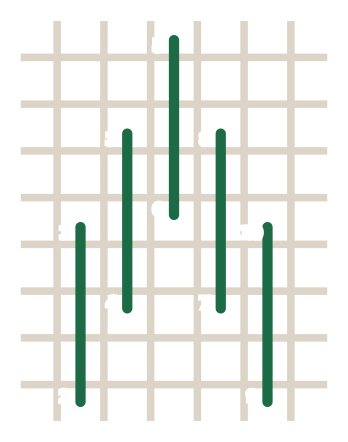
The numbers work as on our stitch guide: the needle comes up at each odd number and goes down at the next even one. Their order follows a tip from Nordic Needle: where the line climbs, work each stitch from the top down, and where it falls, from the bottom up. That leaves longer stitches on the back, which Nordic Needle says makes the stitches strong and helps them lie well. We follow it for the first row only; in the rows after it, Lizart's rule, under coverage below, takes over.
Counts vary with the pattern. NeedlepointTeacher.com says a stitch can cross anywhere from two to eight threads. Patterns that Lizart calls Hungarian point mix stitches over two and over six; the name also serves for Bargello as a whole, and Nordic Needle points out that it is not the same as Hungarian stitch. Sources differ on odd and even counts: Nordic Needle recommends an even number of threads, while KC Needlepoint in Kansas City says its Bargello patterns typically go over three or five, though its Points pattern goes over four.
The step shapes the line. A bigger step makes steeper, sharper peaks, and a smaller one gentler waves, as Carol Leather, who has taught embroidery since 1992, explains on her site. A group of stitches at the same height rounds the zigzag into a curve. The Embroiderers' Guild describes the flame as sharp zigzags like flickering flames, while ribbon and medallion patterns step more gradually into smooth curves.
How the rows repeat
The first row sets the line. Every row after it, above or below, follows the same path, so the whole piece grows from that one row, as the RSN and PieceWork describe it. Rows can be worked directly next to each other, as in the diagram, where each stitch of row 2 goes into the hole where the stitch above it ends. KC Needlepoint notes that its wave patterns can also be spaced out, with a canvas thread left open between rows.
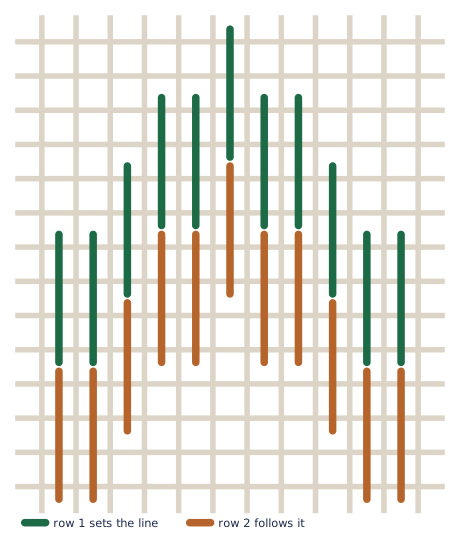
Each row is usually worked in one color, and the colors repeat in order, which makes the bands. The RSN says one color generally goes to one complete wave. Since about 1900, Lizart says, Bargello has usually been worked in shades of one color, sometimes with a contrasting row, while seventeenth-century pieces used many colors, often bright ones. PieceWork calls runs of neighboring colors on the color wheel, from light to dark, the classic choice.
Counting the first row
Because every row copies the first, a miscount there repeats across the whole piece; Nordic Needle warns that a design can end up far off if its foundation line is wrong. Work the first row slowly, and check each group of stitches against the chart before you start the second.
Mark the center of the canvas before you begin. Lizart Needlepoint says every Bargello piece needs at least its center marked, and that the center is marked first; the pattern decides whether it falls on a hole or on a canvas thread. Test any marker on a scrap of the same canvas, since Lizart has found markers that hold on one canvas and bleed on another. It advises against pencil, which can dirty light threads, and calls a basting thread the only foolproof mark.
Where the pattern meets the edge of a shape, the stitches have to be cut short to fit. Lizart advises against an upright stitch over just one thread, which tends to get lost or slip under a canvas thread; lengthen the stitch before it instead.
Canvas, thread, and coverage
Upright stitches let a little canvas show between them. Lizart Needlepoint calls some show-through just about unavoidable with straight stitches. It suggests canvas in a color that goes with the thread, painting the canvas before you start, or backstitches over the gaps once the stitching is done. Nordic Needle suggests matching the canvas to one of the lighter or more prominent colors in the design, and a thicker thread, or threads combined, for more coverage. Lizart uses four to six strands of six-strand floss on 18 mesh, and sometimes one more for dark colors.
Keep the tension slightly loose, so the thread lies on the canvas; pulled tight, the stitches make the holes stand out and can pull the canvas out of shape. Come up through an empty hole and go down through one already in use, which keeps the needle from disturbing the stitches there; in rows after the first, that means coming up at the free end of each stitch. And change direction every row, left to right and then right to left, for more even coverage on the back. All three are Lizart's advice.
For a first piece, Lizart suggests wool or a wool blend, and Carol Leather suggests 10 to 14 mesh, where the holes are large enough to see clearly. Lizart notes that its author learned Bargello on 13 or 14 mesh, and that most stitchers now prefer 18. Our mesh count guide and thread guide explain both choices. The Embroiderers' Guild calls Bargello durable, suited to pillows, rugs, and upholstered furniture.
Bargello in a painted canvas
A Bargello pattern can also fill one part of a painted canvas. NeedlepointTeacher.com suggests it as an accent, a Bargello motif against a background in tent stitch, and KC Needlepoint recommends Bargello patterns for water and for anywhere you want movement. For the other stitches that can fill a large area of a design, see our background stitches guide.
Use it for: water, skies and clouds, rolling hills and mountains, fields, roofs, clothes, and allover patterns for pillows.
From a shop: KC Needlepoint's Stitch Vault has four Bargello patterns: a wave, worked vertically or horizontally, curves for clouds and hills, and points for a roof.
Four-way Bargello
Four-way Bargello turns the pattern at the diagonals. Nordic Needle describes dividing the canvas into four segments: find the center, then go out diagonally to the four corners. The same pattern fills each triangle and turns the corner at each diagonal, the way the molding of a picture frame is mitered, and the finished piece looks like a kaleidoscope; Carol Leather calls these mitered designs. Turned at a diagonal, upright stitches become sideways ones, so the stitches stand upright in two opposite triangles and lie sideways in the other two. The Edmonton Needlecraft Guild describes working out from the center, and eight-way designs that use eight triangles.
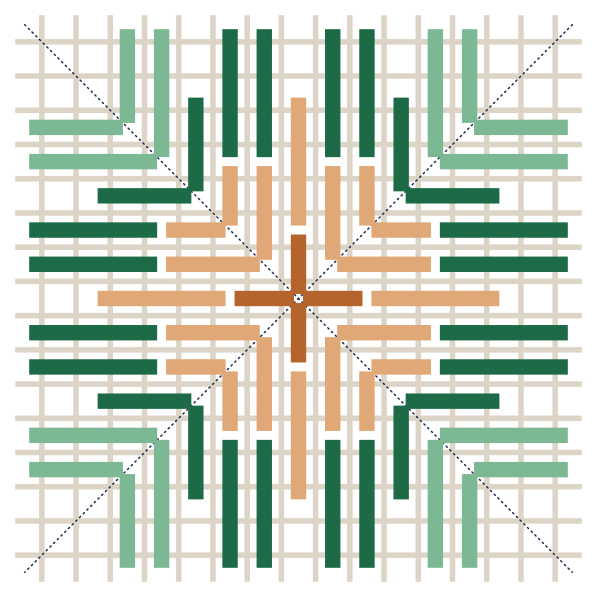
Nordic Needle warns against ruling the diagonals: canvas mesh is not always exactly square, so a ruled line can put stitches in the wrong holes. Stitches that reach a diagonal stop on it. Where that would leave a stitch over one thread, Lizart's advice applies: lengthen the stitch before it in the same column to reach the diagonal instead. The form was popularized by Dorothy Kaestner's book Four Way Bargello, first published in 1972.
Is Bargello hard?
The stitch is not. Carol Leather describes Bargello as straight stitches stepped up and down, with no complicated moves to master, and Nordic Needle calls it relatively easy because its stitches are straight. The counting takes care, above all in the first row. NeedlepointTeacher.com rates Bargello a step harder than easy stitches such as continental and brick, and Lizart finds Hungarian point patterns, with their long and short stitches, difficult until you get the hang of them.
For a first pattern, Carol Leather suggests a simple zigzag or diamond.
Canvases, kits, and books
Local shops sell hand-painted Bargello canvases, and some sell Bargello designs, stitch guides, and books. When we checked shops' own sites in September 2026, The Needlepoint Clubhouse in Rock Hill, near St. Louis, listed Bargello canvases from three painters, on 13, 14, and 18 mesh. KC Needlepoint listed Bargello canvases for an eyeglass case and a key fob. Needlepoint.Com, which has shops in Charleston and Raleigh, listed Bargello and flame stitch canvases. Nashville Needleworks in Brentwood, Tennessee, listed two Bargello designs, Bargello Primer and Bargello Brocade. And Lycette Designs in Palm Beach listed its own intermediate Heart Bargello stitch card, a digital download it calls a friendly guide for learning heart Bargello.
Bargello Needlepoint in Tuckahoe, New York, is named after the technique, in its own words a shop that honors its classic namesake, though its canvases run to florals, holidays, and sayings as well. It sells the Angell sisters' pattern directory, listed below.
Kits and books sold online
As an Amazon Associate, we earn from qualifying purchases. Prices and availability change, so check the current price on Amazon before buying.
Search results for Bargello kits mix in cross stitch and embroidery kits. These are Bargello books and a wool Bargello kit, going by each listing.
- Bargello Needlepoint: A Pattern Directory for Dramatic Creations, by Laura and Lynsey AngellForty stitch patterns graded from beginner to advanced, with charts and color photographs, plus a short history, notes on tools and materials, and a stitch tutorial.
- Modern Bargello, by Tina FrancisFifteen projects in bold colors, from a floor pillow and a lampshade to a brooch and a pincushion, worked in tapestry wool on canvas.
- Bargello: 17 Modern Needlepoint Projects, by Nerrisa PrattSeventeen projects for the home, from pillows and lampshades to plant pot covers and bags, starting from the basics.
- Four Way Bargello, by Dorothy KaestnerDorothy Kaestner's book on four-way Bargello, first published by Scribner in 1972.
- Appletons Wool Bargello Kit, Waves (12-count)Canvas, Appletons wool, a needle, and instructions for a 40 cm (about 16-inch) square, designed by The Bargello Sisters. The same range has Ice Cream and Rainbow ZigZag designs.
FAQ
Is Bargello the same as needlepoint?
Bargello is a kind of needlepoint. It is worked on needlepoint canvas, and what sets it apart is the stitch: upright stitches in stepped rows, instead of the small diagonal tent stitch.
What is the difference between Bargello and Florentine stitch?
They are two names for the same work. The Royal School of Needlework lists Bargello stitch, flame stitch, and Irish stitch among other names for Florentine stitch, and the Textile Research Centre calls Bargello the American term for Florentine work.
What is a 4-2 step in Bargello?
It is the traditional Bargello stitch: each stitch crosses four canvas threads, and the line moves two threads up or down at each step. Patterns also write it as "stitches over 4 with a step of 2". The step diagram on this page shows it with single steps, and the other diagrams add pairs of stitches at one height.
What canvas is best for Bargello?
The Victoria and Albert Museum says Bargello is usually stitched on single-thread canvas. For the mesh, Carol Leather suggests 10 to 14 for a beginner, and Lizart Needlepoint says most stitchers now prefer 18. Canvas in a color that goes with the thread makes the canvas showing between upright stitches less noticeable, Lizart adds.
Can I stitch Bargello on a painted canvas?
Yes. Shops sell hand-painted canvases with Bargello designs, and Bargello patterns also work as stitches inside a painted design, for water, sky, or hills. KC Needlepoint's Stitch Vault has several, for water, sky, hills, and roofs.
Is Bargello quilting the same thing?
No. Bargello quilting borrows the look: strips of fabric are sewn together in the same stepped pattern that Bargello needlepoint is stitched in, as the Edmonton Needlecraft Guild explains. It uses fabric, not canvas.
Is there a shop called Bargello Needlepoint?
Yes. Bargello Needlepoint is a needlepoint shop in Tuckahoe, New York, in Westchester County. Our Westchester page has its address and hours.
A local shop can help you choose a chart, a canvas, and thread for Bargello. Our region pages list the shops we have checked by hand.
Find a Needlepoint Shop Near YouThis page was checked in September 2026 against the Royal School of Needlework's stitch bank, the Victoria and Albert Museum, the Textile Research Centre in Leiden, the Embroiderers' Guild of America, the Edmonton Needlecraft Guild, Nordic Needle's Bargello guide on needlery.org, NeedlepointTeacher.com, Lizart Needlepoint, Carol Leather's needlework-tips-and-techniques.com, PieceWork magazine, Open Library's catalog, and the shops' own sites. The diagrams were drawn for this page from those descriptions.