Needlepoint Stitches, with Diagrams
Tent stitch three ways, six stitches for texture, and the French knot, with numbered diagrams to follow.
Tent stitch is enough to finish any needlepoint canvas, and our how to start needlepoint guide begins with it. This guide goes further, into ten different needlepoint stitches. It covers the three ways to work tent stitch, which look alike from the front but behave differently, then six stitches that add texture, and the French knot.
Nine of the ten stitches have a numbered diagram drawn for this page, and several link to a tutorial or video from a shop we list, for a second look at the same stitch.
On this page: continental, basketweave, half cross, brick, Scotch, mosaic, Nobuko, corduroy, Byzantine, and French knots.
How to read the diagrams
Each diagram shows a small patch of canvas from the front. The pale lines are the canvas threads, and the needle passes through the holes between them.
Follow the numbers in order: up at 1, down at 2, up at 3, and so on. Odd numbers are always where the needle comes up, and even numbers where it goes down. Only the first stitches are numbered, and the caption and text explain the rest. Basketweave is the one exception: there the numbers give the order of the stitches, each beside the hole where that stitch comes up.
A dashed line is the thread's path on the back of the canvas. The two colors only tell parts of a pattern apart, and the key or caption with each diagram says which is which. A paler stitch is one shortened to fit the edge of the drawing.
Stitches are measured by what they cross. A tent stitch crosses one intersection, the point where a vertical and a horizontal thread meet, so it is worked over one. A diagonal stitch over two crosses two intersections, and an upright stitch over two crosses two canvas threads.
Tent stitch, three ways
A tent stitch is a small diagonal over one intersection, usually slanting up to the right. It can be worked three ways, and all three look the same from the front. The difference is on the back, and it decides how much thread the stitching uses, how well it wears, and how far it pulls the canvas out of shape.
Continental stitch
Continental is tent stitch worked in rows. Between one stitch and the next, the thread slants across two canvas threads on the back, so the back fills with long slanted stitches.
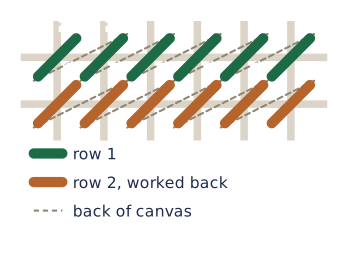
Work the first row from right to left, making each stitch from bottom left to top right. Then work back from left to right, making each stitch from top right to bottom left, which is how the Royal School of Needlework's stitch bank shows it. If you would rather always stitch from right to left, give the canvas a half turn at the end of each row, so the top edge is at the bottom. The stitches come out the same.
Make each row as long as you can: NeedlepointTeacher.com, the site of needlepoint teacher and author Susan Sturgeon Roberts, warns that breaking a row leaves lines that will not block out. Continental pulls the canvas out of shape more than basketweave does, though blocking can straighten it. It is the stitch for small or narrow areas, where diagonal rows will not fit.
From a shop: Needlepoint.Com, which has shops in Charleston and Raleigh, compares continental and basketweave, with diagrams and videos.
Basketweave stitch
Basketweave is tent stitch worked in diagonal rows, and it takes its name from the woven pattern it leaves on the back. It pulls the canvas out of shape least of the three, and it covers and wears best, so it is the one to choose for backgrounds and for pieces that get handled, like pillows and belts.
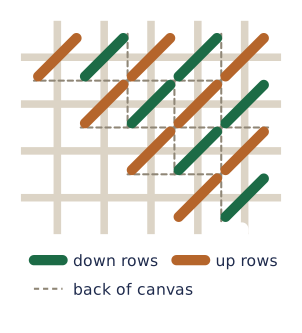
Start at the top right corner of the area and work diagonal rows, one down and the next back up. On a down row the needle points straight down, and on an up row it points sideways, to the left. Each stitch comes up through an empty hole, so the needle is less likely to split the stitches already in place.
Never work two down rows or two up rows side by side. The same site warns that the line this leaves will never block out. On mono canvas, the canvas tells you which way to go. At each intersection one thread lies on top of the other: where the vertical thread is on top, work a down row, and where the horizontal thread is on top, work an up row. Stitchers remember it as up the steps, down the poles. On interlock canvas, just alternate.
From a shop: Needlepoint.Com's guide above covers basketweave too. For left-handed stitchers, Greystone Needlepoint in Bryn Mawr, Pennsylvania, publishes a left-handed basketweave diagram beside its standard one.
Half cross stitch
Half cross leaves only short upright stitches on the back, so it uses the least thread of the three. Work the first row from left to right, making each stitch from bottom left to top right. Work the next row back from right to left, making each stitch from top right to bottom left, or give the canvas a half turn and work every row like the first. Every other row comes up through holes that are already in use.
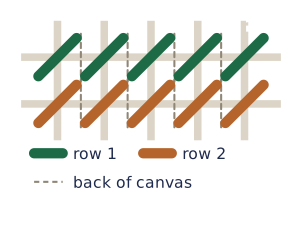
The saving costs strength. Half cross is the weakest of the three, and NeedlepointTeacher.com rates it unsuitable for upholstery, so keep it for pieces that will not be handled much. The site also warns never to use half cross on mono canvas, where the stitches tend to disappear. Our mesh count guide explains mono and interlock canvas.
Six stitches for texture
Each of these gives an area a texture that tent stitch cannot, and most cover ground faster, because their stitches are longer. They are counted stitches, so the pattern has to fit the shape. Where the edge of a shape leaves no room for a whole unit, fill the gap with shorter stitches that follow the pattern. Stitchers call this compensating.
Upright stitches stepped into rows of color make Bargello, which has a guide of its own. Our background stitches guide covers choosing a stitch for a background, with seven more stitches drawn.
Brick stitch
Brick stitch is made of upright stitches over two canvas threads, each set one thread higher or lower than the one beside it. Work along the row in a zigzag, one stitch high and the next low. The next row fits into the steps, so the rows interlock like a brick wall.
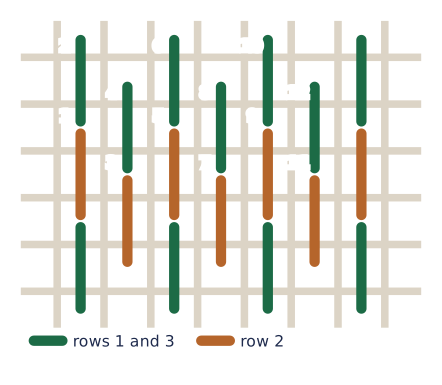
Brick also works turned on its side, with the stitches lying across. Upright stitches always let a little canvas show between them, so The Needlepoint Clubhouse in Rock Hill, near St. Louis, suggests a thicker thread if you want fuller coverage.
Use it for: skies, water, hills and mountains, buildings, hair, and backgrounds.
From a shop: The Needlepoint Clubhouse has a video of brick stitch in its stitch library.
Scotch stitch
Scotch stitch is a small square of five diagonal stitches, over one, two, three, two, and one intersections, all slanting the same way. Each square covers three canvas threads each way. Finish one square before you start the next.
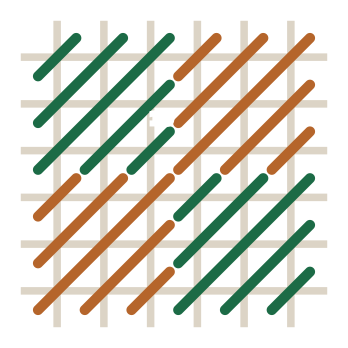
A single line of squares makes a border. Reversed Scotch flips the slant from one square to the next.
Use it for: buildings, borders, backgrounds, clothes, and foliage.
Mosaic stitch
Mosaic is a smaller square, two threads each way: a tent stitch, a stitch over two intersections, and another tent stitch, all slanting the same way. The squares can run in neat rows or fill any spot with room for a two by two square.
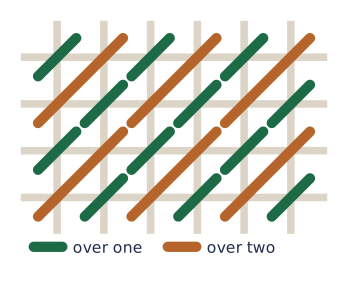
Lycette Designs in Palm Beach calls mosaic "a classic stitch for large backgrounds". The shop finds it easy to compensate and quick to work, and likes it for adding texture beside a large area of continental or basketweave.
Use it for: large backgrounds, and small square spaces anywhere in a design.
Nobuko stitch
Nobuko alternates short diagonal stitches over one intersection with long ones over three, all slanting the same way. Although the stitches are diagonal, you work it in horizontal rows, along one row and back along the next, making every stitch from bottom left to top right.
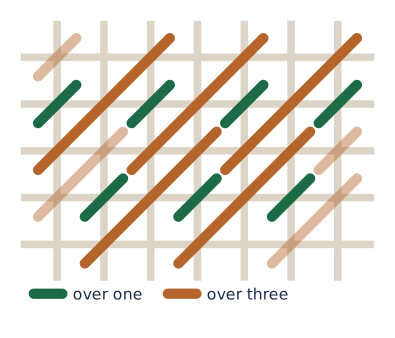
Each new row fits against the one before, long stitches under short ones and short under long, so the rows lock together and cover the canvas.
Use it for: skies, water, snow, animal fur, and other large backgrounds.
From a shop: BeStitched Needlepoint in Scottsdale has a video of the stitch.
Corduroy stitch
Corduroy stripes an area with ribs, like the fabric. Columns of tent stitches alternate with columns of stitches over two intersections, and the two slant in opposite directions: in the diagram, the tent stitches slant up to the left and the longer ones up to the right. It can be worked in rows as well as columns.
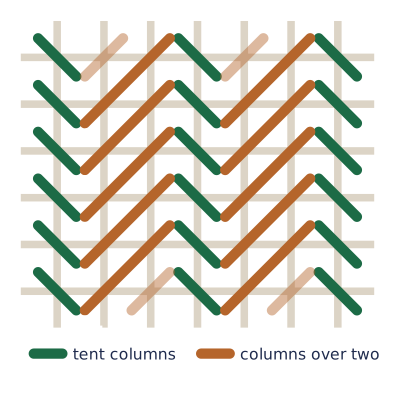
One way to work it is to stitch the tent columns first and then fill the spaces between them with the longer stitches. The Needlepoint Clubhouse calls it a favorite, and recommends it for backgrounds that need a lot of compensating and for walls, floors, and patios.
Use it for: backgrounds, buildings, walls and floors, and clothing.
From a shop: The Needlepoint Clubhouse has a video of corduroy stitch.
Byzantine stitch
Byzantine stitch comes in several versions. Each is a zigzag staircase of diagonal stitches: a run across, then a run down, then across again, with each staircase fitting against the next. The diagram shows one version, with stitches over two intersections in runs of three across and three down, sharing the corner stitch. Other versions use longer stitches, longer runs, or both.
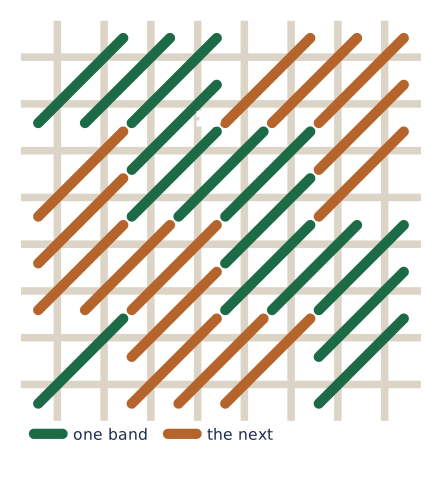
Work each diagonal band in one direction and the next band in the other. KC Needlepoint in Kansas City calls it a busy stitch with lots of movement, and NeedlepointTeacher.com rates it a step harder than brick or Scotch.
Use it for: backgrounds and clothes, anywhere you want movement.
From a shop: The Needlepoint Clubhouse has a video of a Byzantine variation.
French knots
A French knot is a small raised dot that sits on top of the canvas. NeedlepointTeacher.com rates it a step harder than continental, and Needlepoint.Com points out that its steps are hard to learn from a flat diagram, so instead of drawing one we link to Needlepoint.Com's video.
In words: bring the needle up and wrap the thread once around it. Holding the wrap snug on the needle, take the needle down through the next hole, not the one it came up through, and pull through to finish the knot.
For a bigger knot, NeedlepointTeacher.com recommends a thicker thread or more strands, not more wraps. It says knots that come undone have probably been wrapped three times, which leaves them floppy. For something fuller, Nashville Needleworks in Brentwood, Tennessee, explains the colonial knot, a different knot whose thread goes around the needle in a figure eight, which makes it larger.
Needlepoint.Com suggests a single-strand thread for your first knots, practiced in the blank margin around the design before you start on the piece.
Use it for: hair and beards, fur, greenery and flowers, birds, and small details like eyes or berries. Not usually for backgrounds: Needlepoint.Com notes that knots can easily overpower the rest of a piece.
How to practice a new stitch
Try a new stitch on a scrap of canvas, or in the blank margin of the canvas you are working on, before it goes into the design. A few rows show you the rhythm of the stitch, and working it in the thread you plan to use shows you the texture you will get.
Some canvases are sold with a stitch guide, a set of notes saying which stitch to use where. And a shop can show you a stitch in person: Lowcountry Needlepoint in Charleston, for one, follows its beginner class with decorative stitch classes.
FAQ
Do I need to learn other stitches, or is tent stitch enough?
Tent stitch alone can finish any canvas. The other stitches are optional. They add texture, cover large areas faster, or suit a particular part of a design, like brick for a sky or French knots for hair.
What is the difference between continental and basketweave?
Both are tent stitch and look the same from the front. Continental is worked in straight rows and leaves long slanted stitches on the back. Basketweave is worked in diagonal rows, leaves a woven pattern on the back, and pulls the canvas out of shape less. Use basketweave for backgrounds and continental where diagonal rows will not fit.
Which stitch is best for a background?
Choose basketweave if you want the smooth look of tent stitch. For texture, mosaic, Nobuko, brick, and corduroy are all recommended for backgrounds by the teachers and shops cited on this page. Our background stitches guide covers how to choose one, and seven more stitches, among them T-stitch, skip tent, and cashmere.
What does "over two" mean?
It counts what a stitch crosses. A diagonal stitch over two crosses two intersections of the canvas, and an upright stitch over two crosses two canvas threads. Tent stitch is the smallest, over one.
Are decorative stitches harder to learn?
Some are. NeedlepointTeacher.com rates continental, brick, and Scotch as easy, and Byzantine and French knots a step harder. A numbered diagram, a video, or a shop class makes any of them quicker to pick up.
A local shop can show you a new stitch in person, and some run stitch classes. Our region pages list the shops we have checked by hand.
Find a Needlepoint Shop Near YouThe stitches on this page were checked in September 2026 against NeedlepointTeacher.com, the Royal School of Needlework's stitch bank, the stitch libraries of KC Needlepoint and Unwind Studio, and the shop tutorials linked above. The diagrams were drawn for this page from those descriptions.