Needlepoint vs. Cross Stitch: What's the Difference?
Both are stitched into the holes of a grid, but needlepoint lays mostly slanted stitches on stiff canvas, and cross stitch lays X-shaped ones on fabric, most often Aida.
The two have a lot in common. The Victoria and Albert Museum counts both among the counted kinds of embroidery, where each stitch covers a set number of threads in the ground. Both use a blunt needle, and both can be stitched from a chart. The difference lies mainly in the ground, and usually in the stitch. Needlepoint is worked on stiff, open canvas, most often in tent stitch, one slanted stitch over each crossing of the canvas threads. Cross stitch is worked on fabric such as Aida, in stitches shaped like an X.
This page says what each craft is, then sets them side by side: the canvas and the fabric, the stitches from the front and the back, where the design comes from, the supplies, and what each is used for. Our needlepoint vs. embroidery guide adds freestyle embroidery to the comparison.
On this page: what needlepoint is, what cross stitch is, canvas and Aida, the stitches, front and back, canvases and charts, needles, thread, and frames, what each is used for, side by side, which is easier, and the FAQ.
What is needlepoint?
Needlepoint is embroidery worked on canvas, a stiff, open weave with a hole in every space between its threads. You stitch through those holes, one stitch at a time, until the design is covered. In the Victoria and Albert Museum's description, canvas work is most often in tent stitch, a diagonal stitch, and its designs generally cover the whole canvas. The Royal School of Needlework (RSN) calls needlepoint canvaswork, and the Embroiderers' Guild of America (EGA) calls it an American term for canvas embroidery.
Needle 'n Thread, an embroidery site, gives two sources of a needlepoint design: a gridded chart, counted onto blank canvas, or paint on the canvas itself, with each painted area stitched in thread of the corresponding color.
The word has two other uses. The EGA's glossary also gives needlepoint as the name of a lace made with a needle, and the RSN's Stitch Bank lists needlepoint, with petit point, as another name for tent stitch itself. Needlepoint in wool also goes by another name, tapestry, which the RSN calls incorrect; Nordic Needle points out that a tapestry is woven rather than stitched.
What is cross stitch?
Cross stitch is embroidery in stitches shaped like an X. The Victoria and Albert Museum describes the stitch as two diagonal lines crossed, the second over the first. The RSN's Stitch Bank says the top stitches should all lie in the same direction. It gives two ways to work a cross: each cross whole, one at a time, or along a row, the first diagonal of each cross going out and the second coming back. DMC, the thread maker, calls the row method the usual one.
DMC says cross stitch designs usually come as a chart rather than printed on the fabric, and calls Aida, a fabric woven in blocks of threads with clearly defined holes, the most popular fabric for cross stitch. On a chart, the EGA's glossary says, each square stands for one cross stitch. The EGA also names a second technique, printed cross stitch, worked on fabric with the stitches printed on it.
Aida is younger than the craft. DMC dates it to 1890, and says that before then cross stitch was worked over two threads each way of a woven fabric, as it still is on other fabrics. The Cross Stitch Guild notes that 28-count linen worked over two threads gives the same design size as 14-count Aida.
Canvas and Aida
Canvas, as the EGA's glossary describes it, is starched stiff and woven open like a lattice, in cotton, silk, linen, or man-made fibers, with anywhere from 4 to 64 threads to the inch. In Aida, the Cross Stitch Guild explains, the threads are woven in bundles that make a pattern of squares, with obvious holes for the stitches.
If you hold both, the canvas is the one that feels stiff and open. In its guide to choosing canvas, Erica Wilson, which has shops on Nantucket and Martha's Vineyard, sets needlepoint canvas apart from cross stitch and embroidery fabric as stiff and open, "with visible holes that guide your needle." Aida can be stiff when new, too. DMC says some Aida is treated with a dressing that stiffens it, and that washing takes the dressing out.
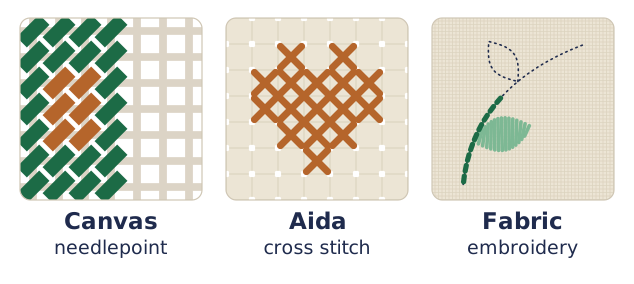
Both grounds are sized by how many stitches fit in an inch. Canvas is sized by its mesh, the number of threads to the inch, which the EGA's glossary also calls its count. A tent stitch covers one crossing of threads, so 18-mesh canvas takes 18 stitches to the inch. Aida is sized by its count, which DMC defines as the number of stitches you can make in an inch, and DMC recommends 14-count Aida for beginners. So 18-mesh canvas and 18-count Aida make stitches the same size. Our mesh count guide explains what the mesh means for a project.
The stitches, front and back
A tent stitch is one diagonal over one intersection, where two canvas threads cross, as the EGA's glossary defines it, and the RSN's Stitch Bank says it is usually worked from bottom left to top right. The Victoria and Albert Museum's other name for it, half cross, shows how the two stitches relate. A cross stitch is that diagonal with a second laid over it, slanting the other way, making an X over one block of Aida. Half cross also names one of the three ways of working tent stitch, below.
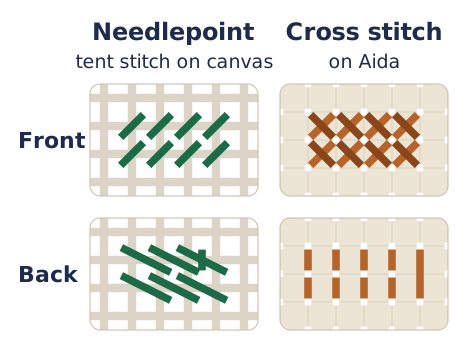
From the front, the difference is the X. From the back, it depends on how the stitches were worked. The RSN's Stitch Bank says continental tent stitch, worked in rows, makes a diagonal on the back longer than the one in front, and that cross stitch worked in rows shows vertical straight stitches on the reverse.
Tent stitch can be worked three ways that look alike from the front and differ behind, as the RSN and Nordic Needle both say. Nordic Needle says basketweave leaves its own pattern on the back, and half cross only a short stitch over one canvas thread, which uses the least thread. Our stitch guide draws all three.
How much of the ground is covered does not settle which craft you are looking at. Of counted embroidery in general, the Victoria and Albert Museum says some styles leave the background fabric visible and others cover it entirely. Nordic Needle notes that in modern canvaswork the background canvas can be part of the design, and our background stitches guide has two stitches that leave canvas showing on purpose. The ground settles it. The museum defines canvas work as any embroidery on canvas, as opposed to other fabrics. So stitches on stiff, open canvas are needlepoint, even crosses, and crosses on Aida or linen are cross stitch.
Each craft has more than its main stitch. Any embroidery stitch can be used on canvas, the EGA's glossary says, and our stitch guide and background stitches guide cover the ones to learn after tent stitch. On a cross stitch chart, DMC says, the cross is the most common stitch, and backstitch, used for outlines and lettering, comes next. Cross stitch charts sometimes call for half, quarter, and three-quarter stitches too, which DMC calls fractional stitches.
Canvases with the design on them, and charts
Canvases with the design already on them come two ways. Lycette Designs in Palm Beach, in its guide to types of needlepoint, describes hand-painted canvases as individually crafted by artists who paint each design onto the canvas, and stamped, or pre-printed, canvases as having the design applied by machine. Either way, you follow the colors rather than count. Our kit guide compares pre-printed canvas kits, hand-painted canvases, and all-in-one kits.
Charted needlepoint goes back at least to the 1800s. The Victoria and Albert Museum says Berlin woolwork was stitched from patterns printed on squared paper, each square corresponding to a square of the canvas. The patterns sold in large numbers, the museum adds, creating something of a craze in Victorian Britain.
For cross stitch, the chart is the usual route and printed fabric the exception. DMC suggests starting in the middle of the design and the middle of the fabric, then counting holes out from the stitches already made. A chart counts the same way on canvas, which is how a cross stitch pattern can become needlepoint; the FAQ below explains how.
Needles, thread, and frames
Both crafts use a blunt needle with a long eye, a tapestry needle in the EGA's terms. John James, which makes needles in England, says sizes 22, 24, 26, and 28 of its tapestry needles are the ones commonly used for cross stitch. DMC's list of cross stitch essentials includes a needle with a blunt point and an elongated eye. Our supplies guide gives the needle size for each needlepoint mesh.
Thread overlaps too. Cross stitch is usually worked in stranded embroidery floss, DMC says, and six-strand floss works on canvas as well, in more strands at a time. The EGA says embroidery typically takes one or two strands of floss at a time, depending on the pattern and the fabric. Needlepoint.Com, with shops in Charleston and Raleigh, gives four strands of floss for 18-mesh in its thread chart, and seven or eight for 13-mesh, which takes strands from two six-strand lengths. On canvas, Needle 'n Thread says, all types of thread can be used, among them wool, silk, cotton, and blends, and our thread guide covers them.
The frames differ more. The EGA's glossary lists artist's stretcher bars and scroll frames for needlepoint, and says a frame helps keep the canvas from distorting while you stitch. Cross stitch is most often held in a hoop: a majority of stitchers use one for it, Nordic Needle says, with a frame or stretcher bars for large pieces. DMC suggests a hoop for neat, even stitches, and a frame for larger projects.
What each is used for
- Needlepoint has long been made into furnishings. The Victoria and Albert Museum says canvas work made upholstered furniture, pillow covers, and bed hangings from the sixteenth century on, and Berlin woolwork made furniture coverings for the Victorian home. Lycette Designs says needlepoint is typically used for "items that need to withstand wear and tear, such as furniture upholstery, handbags, and belts." Our finishing guide covers having a canvas made into a pillow, an ornament, or a stocking.
- Cross stitch was traditionally used on household linens and kept alive by samplers, the EGA says, and today it is "primarily used to create decorative (rather than utilitarian) items." DMC adds that cross stitch is used to mend or embellish clothes, and it advises leaving a border of at least 3 inches around a design that will be mounted and framed.
Side by side
- The ground. Needlepoint: canvas, stiff and open, sized by its mesh. Cross stitch: Aida, or an evenweave cloth such as linen, sized by its count.
- The stitch. Needlepoint: mostly tent stitch, a single diagonal over each crossing of threads, among many others. Cross stitch: an X of two diagonals, and occasionally a backstitch for outlines.
- The back. Needlepoint: it depends on the method, and continental leaves longer diagonals. Cross stitch worked in rows: short upright stitches.
- The design. Needlepoint: painted or printed on the canvas, or counted from a chart. Cross stitch: counted from a chart, or printed on the fabric.
- Thread. Needlepoint: almost any thread, among them wool, silk, cotton, and blends. Cross stitch: usually stranded floss.
- The needle. Both: a blunt tapestry needle.
- Holding it taut. Needlepoint: often a frame, either stretcher bars or a scroll frame. Cross stitch: most often a hoop, with a frame for a big piece.
- Typical pieces. Needlepoint: pillows, upholstery, handbags, belts, ornaments, and stockings. Cross stitch: samplers, household linens, framed pieces, and mended or embellished clothing.
Which one is easier to learn?
No source we read compares the two for difficulty. They differ in what comes first.
On a painted needlepoint canvas, you learn one stitch and follow the colors in front of you. NeedlepointTeacher.com rates continental, a tent stitch worked in rows, "Easy," and our how to start guide explains that a first canvas needs no other stitch.
Cross stitch starts with counting. DMC calls it ideal for beginners, since it uses only the cross and occasionally a backstitch, and says Aida's obvious holes make neat stitches easy to form. Much of DMC's advice for beginners is about counting: work close to the stitches already made, and work in rows, so that a counting mistake is easier to unpick.
Charted needlepoint asks for both, counting and a stitch that suits a chart, as the FAQ below explains. Our needlepoint vs. embroidery guide compares the first steps in freestyle embroidery too.
FAQ
Is needlepoint the same thing as cross stitch?
No. The Victoria and Albert Museum lists both among the counted kinds of embroidery, but they use different grounds and different stitches. Needlepoint is worked on stiff canvas, usually in tent stitch, and cross stitch in X-shaped stitches on a fabric such as Aida.
Can you use a cross stitch pattern for needlepoint?
Yes. Each square of a cross stitch chart stands for one cross stitch, the EGA's glossary says, and on canvas each square becomes a tent stitch, as the needlecraft retailer Herrschners treats it in its advice on adapting charts. Herrschners says charts that are easy to adapt generally have large blocks of color and almost no partial stitches, and are charted for a fabric count close to a common canvas mesh. For a chart with many half and quarter stitches, it suggests Penelope canvas, whose pairs of threads can be split for the smaller stitches.
The stitch matters too. Herrschners says a stitcher used to basketweave on painted canvases may find basketweave hard to work from a chart. It suggests painting the main shapes onto the canvas first, which makes the basketweave much easier to follow. For an intricate chart it suggests half cross instead, which is worked in rows and much easier to work from a chart, though it covers the canvas less well. To make up for that, Herrschners gives three remedies: tinting the largest color areas of the canvas, working on a higher mesh, and adding one or more plies of thread. NeedlepointTeacher.com warns against half cross on mono canvas, where the stitches tend to disappear, and says it works well on interlock; our stitch guide's half cross section has more.
The size changes with the mesh. By our arithmetic, a design seventy stitches wide is 5 inches on 14-count Aida or 14-mesh canvas, about 5.4 inches on 13-mesh, and just under 4 inches on 18-mesh, so a higher mesh also shrinks the design.
Can you cross stitch on needlepoint canvas?
Yes, and by this page's test the result is needlepoint worked in cross stitch. The RSN's Stitch Bank counts cross stitch among canvaswork stitches. It says Mary, Queen of Scots, and her household stitched canvaswork pieces in cross stitch, and that Berlin woolwork had made cross stitch on canvas very popular by the middle of the nineteenth century. Erica Wilson's own FAQ calls using one canvas for both possible, though needlepoint canvas and cross stitch fabric are designed differently: the canvas is stiffer, with larger, more defined holes for thicker threads.
For crosses on mono canvas, the needlepoint teacher Ellen Johnson, of Serendipity Needleworks, advises finishing each cross before moving along the row, which helps keep the canvas from distorting. The same post suggests a slightly thinner thread than usual, since a cross is a layered stitch. Cross stitchers use canvas another way too. Waste canvas, in the EGA's glossary, is canvas you stitch through to put a counted design on a fabric you cannot count; afterward you dampen it and pull its threads out, and only the cross stitches stay.
Which is more expensive, needlepoint or cross stitch?
We have priced needlepoint, not cross stitch, so we cannot compare the two. In the needlepoint shop catalogs we read in September 2026, a hand-painted canvas had a median price of $78, with thread and finishing on top. Our guide to why needlepoint is so expensive breaks those costs down and gives cheaper ways in.
Can I switch between the two, or should I pick one?
You can do both. Some needlepoint shops sell cross stitch supplies too, and our needlepoint vs. embroidery guide names three of them.
Curious to see the difference in person? A needlepoint shop can put the canvas and threads in your hands.
Find a Needlepoint Shop Near YouThis page was checked in September 2026 against the Victoria and Albert Museum, the Royal School of Needlework and its Stitch Bank, the Embroiderers' Guild of America's glossary and beginner guides, Nordic Needle's guides on needlery.org, Needle 'n Thread, NeedlepointTeacher.com, John James needles, DMC, The Cross Stitch Guild, Serendipity Needleworks, Herrschners, and the shops' own sites, among them Lycette Designs' guide to types of needlepoint (May 2024). The front and back figure was drawn for this page from those descriptions, and the grounds figure for our needlepoint vs. embroidery guide. The canvas price comes from the shop catalogs read for our cost guide on September 28, 2026.